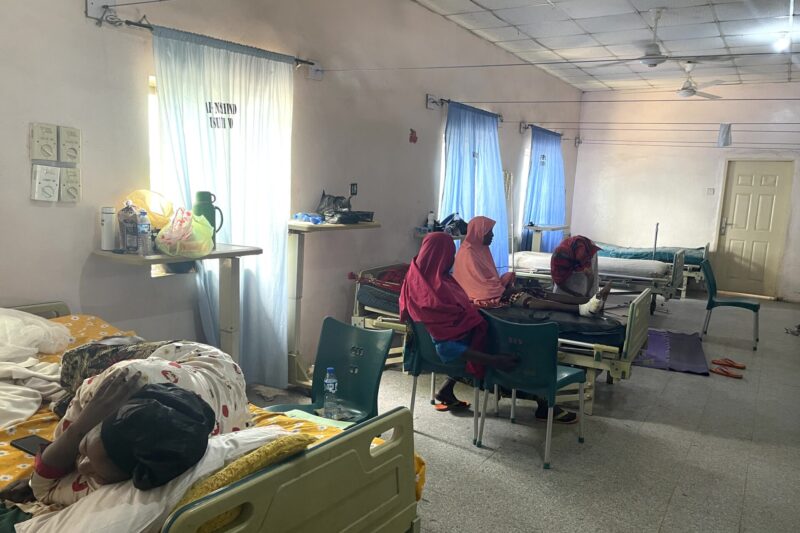
For many decades, the business of repairing engine generators has been a main source of livelihood for hundreds of thousands of young men and women in Nigeria. Nigeria, a country with a population of over 200 million, has more than half of its population struggling to enjoy a constant power supply due to many factors, including institutional corruption, underinvestment in new generation infrastructure, over-reliance on fossil fuels, and the vandalization of power infrastructure by non-state actors, which has pushed millions to rely on backup power solutions such as engine generators.
Low patronage after fuel subsidy removal
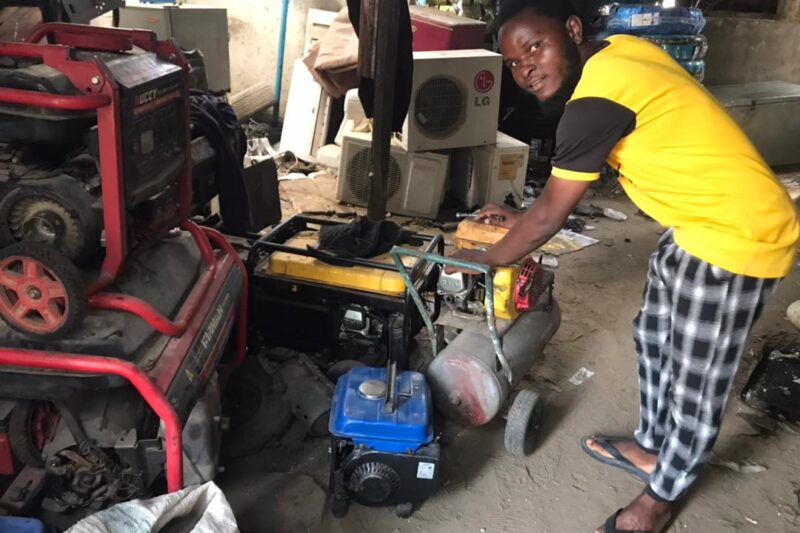
Adamu Abdullahi, 30, an engine generator mechanic, was living a relatively good life with his wife and two children five years ago when the business was booming due to high demand from the public and business owners.
“I have been in this business for 11 years now,” he said. “But the past three years have been extremely tough for us because of low patronage.”
The engine generator technician said that in the past, he used to switch off his mobile phone and dodge customers because of multiple requests.
“The demand was very high in the past, so we decided who to attend to and when, unlike now.”
“I used to repair between 13-16 broken or faulty generators daily,” he said. “It has been two years since we experienced a dramatic change in patronage after the removal of fuel subsidy. Now, we repair less than three engines a day.”
Nigeria is a major importer of engine generators in Africa
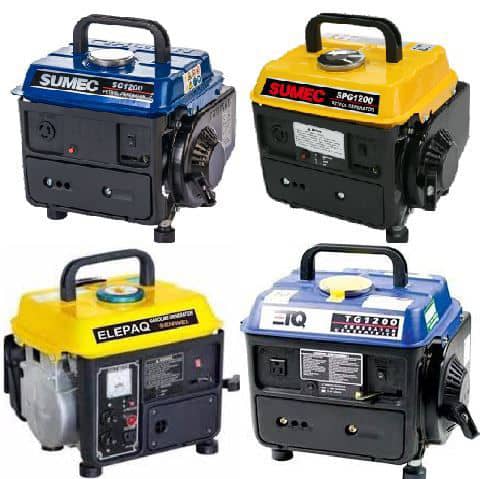
Nigeria has been the major supplier of engine generators in the African continent. The situation is compounded by the inability of the state to provide a constant power supply.
According to the Nigeria Generator Market 2024 report, Nigeria is a significant importer of engine generators in Africa. The report said that in 2024, Nigeria’s generator imports decreased by 1.1% to $408 million, following four years of growth.
They’re counting profits while we count losses daily
The failure of the country to provide its citizens with a constant power supply was seen as a business opportunity by engine generator vendors like Bashir Mohammad Sabo.
“It was a great business in the past because of the high public demand,” he said. “I used to sell between three to five engines daily, but now we hardly sell three in a month.”
Just like Abdullahi (the generator mechanic), Sabo is also not very sure if he will continue in the business for the next three months.
“Most of my colleagues have changed businesses; the majority of them are now into renewable energy,” he said. “They are counting profits while we are counting losses on a daily basis.”
Nigeria’s power supply struggles
Nigeria’s current electricity generation is around 5,100-6,000 megawatts (MW), with a peak generation of 6,003MW recorded in March 2025. However, the country needs significantly more to ensure an uninterrupted power supply.
According to the Minister of Power, Adebayo Adelabu, Nigeria requires investments worth about $262 billion to achieve its ambitious target of expanding electricity generation capacity to 30,000MW by 2030. The country’s estimated energy demand is over 98,000MW, highlighting a substantial gap between current generation and actual demand.