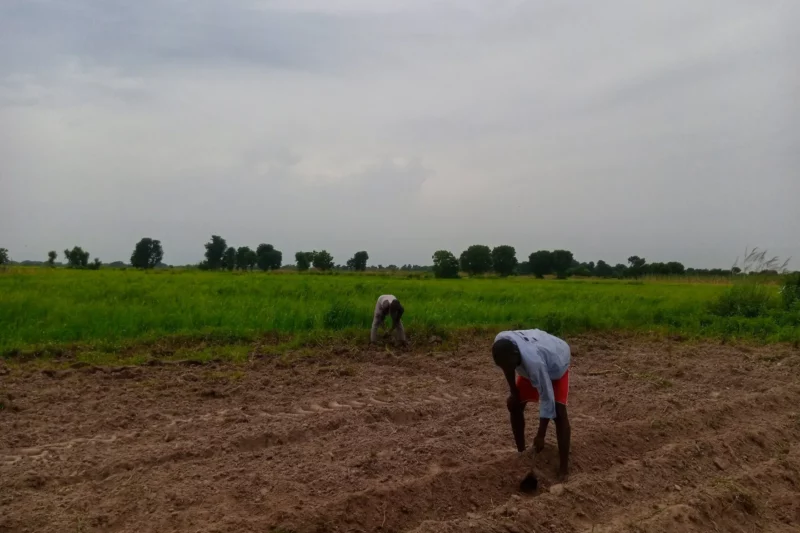
As dawn breaks over Nguro forest in Konduga Local Government Area of Borno State, Mallam Amsami Maina Aji moves through his farmland, clearing bushes and preparing the soil for the 2026 farming season. For more than four decades, farming has been his way of life.
The farmer, who started farming independently in 1983, cultivates maize, millet, beans, wheat, watermelon and okra. But this year, like many others across Borno State, he is preparing for a farming season clouded by uncertainty.
The changes in rainfall patterns and persistent attacks by suspected Boko Haram insurgents have combined to make farming increasingly difficult.
“This has really brought delays in my farming activities. Had it been last year, I would have passed this level by now,” he said.
Across Borno State, agriculture remains the backbone of livelihoods. According to the Borno State Investment Promotion Agency, the sector provides livelihoods for more than 80 per cent of the state’s population and directly or indirectly engages over 65 per cent of residents, making it the dominant economic activity in the state.
Yet the sector is increasingly under pressure. Interviews conducted in Konduga, Damboa, Magumeri and Gajiganna reveal how insecurity and changing weather patterns are restricting access to farmlands and threatening agricultural production.
The situation comes amid a wider humanitarian crisis in North-East Nigeria. The International Committee of the Red Cross (ICRC) reports that more than 3.7 million people across the conflict-affected region are currently facing food insecurity. Meanwhile, the World Food Programme (WFP) estimates that about 2.3 million people have been displaced by violence and insecurity in the North-East, while nearly 5.8 million people in Borno, Adamawa and Yobe states are projected to face severe food insecurity during the 2026 lean season.
For farmers whose livelihoods depend entirely on the land, the combined impact of insecurity and climate change is becoming increasingly difficult to ignore.
“The rainy season has changed. There are fluctuations and delays,” Aji said.
According to him, insecurity remains an even greater concern. Before the commencement of this year’s farming activities, several farmers were reportedly abducted or killed, forcing many others to abandon their farms.
“As a farmer in Konduga, you cannot go beyond two kilometres from the community,” he explained.
“Ideally, if I am able to farm freely, I would produce enough food to sell in the market and keep some for my family’s consumption until the next farming season. But this is not possible now, and with all indications, things may become worse this year.”
He recalled how farmers once cultivated lands in Tempo, Barracks, Bala, Kunkunbe, Sojiri, Ngadiya, Ayanari and Kayamari.
“These areas are no longer accessible, and that is a major setback not only for farmers but for the state as a whole.”
For support, he believes farmers need climate-resilient seeds and improved security.
“Climate-resilient seeds and an end to insurgent attacks are what we need from the government.”
Yet despite the challenges, he remains determined to continue farming.
“What keeps me hopeful is that farming still helps me feed my family. If I abandon farming, what will support my livelihood and that of my family?”
Shrinking Access to Farmland
Hundreds of kilometres away in Damboa Local Government Area, Abba Ibrahim shares a similar concern.
For the past 20 years, he has farmed independently, cultivating wheat, maize, groundnuts, beans and rice.
“Before insecurity and climate change started affecting us, my farm could produce up to 40 bags in a year,” he said.
The harvest would provide food for his family, seeds for the next season and produce for sale in local markets.
Currently, he has planted groundnuts, rice and wheat while waiting for rainfall to stabilise before planting maize.
The greatest challenge, he says, is insecurity.
“When a farmer loses access to where he normally farms, it definitely affects productivity.”
According to him, most farmlands located in the southern and western parts of Damboa are currently inaccessible due to persistent attacks and kidnappings.
“If they find you, it is either you give them the money they ask for, which can run into millions of naira, or they kill you.”
Despite the risks, farmers remain unwilling to abandon agriculture.
“How can we go on with our lives if we stop farming?” he asked.
The result has been a concentration of farmers in the few areas considered relatively safe, mainly along routes leading towards Maiduguri.
“If it was before, we could go up to six kilometres into the fields. Now only about three kilometres are accessible.”
The economic consequences have also been severe.
“Last year, I invested about four hundred thousand naira into farming, but because of attacks and fluctuations in rainfall, I ended up making losses.”
With reduced income, he can no longer cultivate the same amount of land.
“Last year, I planted about 20 bowls of groundnuts. This year, I can only afford seven.”
He called for government support through fertiliser subsidies and improved security measures.
“Fertiliser is costly and many of us cannot afford it. We also need intervention from government to make farmlands safer.”
Paying to Farm
In Magumeri Local Government Area, Karumi Mohammed Titiya paints an even more troubling picture.
According to him, while some farmers have begun cultivation, others remain unable to access their farmlands.
He explained that although farmers successfully cultivated crops last year, insurgents reportedly prevented many from harvesting unless they paid money.
“This year, before farming even began, they requested money from farmers before allowing access to some farmlands.”
The arrangement, he said, came with conditions.
“Communities gathered between seven hundred thousand to one million naira before they were allowed to farm.”
According to him, only a few communities reportedly refused to comply.
Though farming activities have resumed in some locations, he fears the arrangement offers no long-term solution.
“They might change their minds when farming ends, and that will become another challenge for us.”
The consequences are already visible.
“People who used to provide food for others are now struggling to feed themselves. Some have lost their income and could not farm this year.”
He hopes government intervention will provide lasting security.
The local government chairman, he noted, promised security escorts for farmers. However, similar arrangements in previous years yielded limited results.
“We need security forces to understand the routes these insurgents use so they can eliminate the threat completely.”
Farmers Forced Across State Borders
In Gajiganna, the situation has taken a different turn.
Faced with growing insecurity, many farmers have reportedly left their communities and moved to Damaturu in neighbouring Yobe State to continue farming.
A 40-year-old farmer told Ndarason that village leaders advised residents to seek alternative farmland elsewhere.
“We were told to pack our essentials and think about getting farmland in Damaturu because farming here is no longer possible.”
According to him, at least 500 farmers from Gajiganna have already secured farmland in Damaturu.
The movement of farmers from Gajiganna reflects a broader displacement crisis affecting the North-East. According to the International Organization for Migration’s latest Displacement Tracking Matrix, more than 2.3 million internally displaced persons are spread across the six states of the region. While many were displaced by conflict, others continue to move in search of safer livelihoods and access to farmland.
However, relocation has come with conditions.
“They told us that if we come to farm in Damaturu, we should be prepared to stay and not just farm and leave.”
Despite settling temporarily elsewhere, many farmers hope to return home.
“There is no place like home. If our farmlands become secure again, those who left will definitely come back.”
Security Agencies Seek Community Collaboration
Responding to concerns raised by farmers, Chief Superintendent Bukar A. Bukar of the Agro Rangers Unit in Borno State said the security outfit was established specifically to protect farmlands and farming communities across the State.
According to him, while the unit is aware of security challenges affecting farming activities in several locations, every farming season comes with unique security concerns that require collaboration between communities and security agencies.
“We are aware of some of these locations facing security challenges, but communities also need to help us with information,” he said.
“They should come to us and report locations they know have become inaccessible. When we work together and share information, things will definitely improve.”
He noted that information obtained directly from affected communities often provides a clearer understanding of security threats than intelligence gathered from other sources.
“Getting information directly from those affected gives us a broader picture of what is happening on the ground. That information helps us respond better and plan our operations effectively.”
He urged residents to promptly report suspicious activities around farmlands to enable security personnel take necessary action.
Government Promises Improved security for Farmers
The Commissioner for Agriculture, Engr. Bawu Musami, said measures aimed at improving security around farming communities are already underway.
Speaking to Ndarason, Musami acknowledged that the security challenges facing farmers this year are more severe than those experienced in previous years. However, he assured residents that the state government is working with relevant stakeholders to address the situation.
“The security challenge this year is greater than what we experienced in the past, but measures are being put in place to tackle it,” he said.
According to the commissioner, the deployment of forest guards, the activities of Agro Rangers and the continued presence of military personnel will help reduce attacks on farmers and improve access to farmlands.
“Forest guards, which were not available last year, will be effective this year. Together with the Agro Rangers and military personnel, they will help in curtailing attacks by insurgents on farmers,” he said.
Musami also disclosed that the Ministry of Agriculture plans to meet with leaders from local government areas affected by insecurity to discuss ways of improving safety for farming communities.
“We will engage with leaders from the affected local government areas to see how we can work together and take the necessary measures to support farmers.”
The commissioner expressed confidence that the planned interventions would begin yielding results soon, assuring farmers that the government remains committed to protecting livelihoods and strengthening agricultural production across the state.
Climate Change Adds Another Layer
Bulama Garba GongGlong, a Farmer Field School Facilitator and extension agent in Borno State, said climate change has become an unavoidable reality for agricultural communities.
“Climate change is real, known and visible. It is taking farming activities backward and bringing many challenges.”
He attributed part of the problem to human activities such as increasing vehicle emissions, population growth resulting from displacement and deforestation.
“If we look at years back, the rainy season could last up to five months. Today, it may last only three months.”
This has major implications for farmers.
“If a crop normally takes four months to mature, it becomes difficult to grow under a three-month rainy season.”
To adapt, he encouraged farmers to embrace climate-smart agricultural practices and early-maturing seed varieties.
“If you previously planted beans that mature in four months, you should switch to varieties that mature in three months.”
He stressed the importance of monitoring weather forecasts and adjusting planting decisions accordingly.
“Nature cannot be changed. Farmers must adjust to the pattern of rainfall.”
A Double Burden
For many farmers across Borno State, climate change and insecurity now form a double burden.
While shorter and less predictable rainy seasons threaten yields, insecurity limits access to farmland and delays critical farming activities.
“In Maiduguri, farmers can no longer go beyond about five kilometres from town due to security concerns. In many local government areas, access is limited to only two kilometres,” GongGlong explained.
“When attacks happen, they delay farming activities and affect overall production.”
The consequences extend beyond individual farmers.
According to the World Food Programme, nearly 5.8 million people in Borno, Adamawa and Yobe states are expected to face severe food insecurity during the 2026 lean season. Humanitarian agencies attribute the situation to a combination of conflict, displacement, climate shocks and declining agricultural production.
For a state where agriculture provides livelihoods for more than 80 per cent of the population, every abandoned farmland, delayed planting season and reduced harvest carries consequences far beyond farming communities. Reduced cultivation and lower harvests contribute to rising food prices, shrinking household incomes and growing concerns over food security across the region.
To help farmers adapt, GongGlong recommended climate-resilient seeds such as OHO varieties developed through agricultural research.
“These seeds mature in about 80 days and yield better than traditional varieties that take up to 120 days.”
On security, he urged authorities to strengthen protection for farming communities.
“Security agencies should escort farmers to their fields and ensure farmlands are safe. This will help a lot.”
As clouds begin to gather over Borno’s skies ahead of another rainy season, farmers like Mallam Amsami Maina Aji continue clearing their fields, hoping for a better harvest despite the odds.
Across Konduga, Damboa, Magumeri and Gajiganna, the story is largely the same. Farmers are adapting to shorter rainy seasons, shrinking access to farmland and persistent security threats. Yet they continue to plant because farming remains their only source of livelihood.
For many of them, abandoning farming is not an option.
“What will support my family if I stop farming?” Aji asked.
It is a question echoed across Borno’s farming communities — a reminder that behind every bag of grain harvested is a farmer battling not only climate change, but also insecurity, uncertainty and the struggle to survive.
Rukaiya Ahmed Alibe