

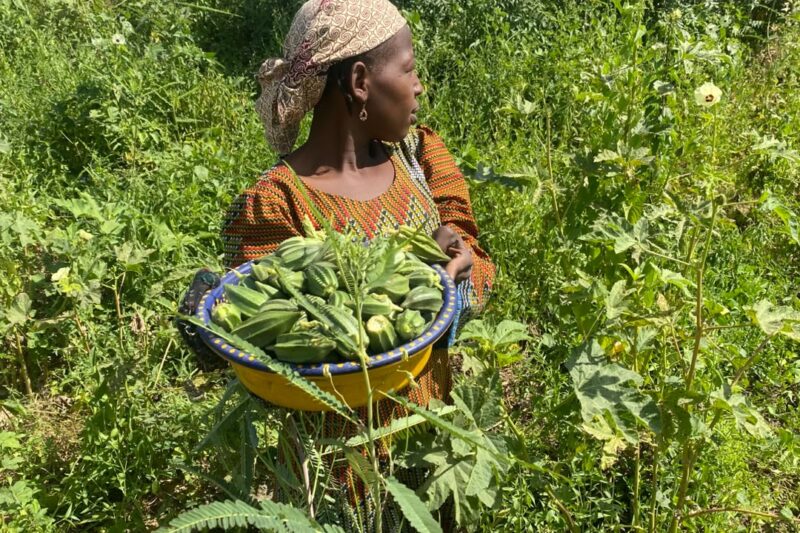
At 25, Hauwa Mohammed measures time not by years, but by harvests.
It has been nine years since she fled her village of Dalwa in Konduga Local Government Area, as armed conflict swept through Borno State. She was 16 then. Today, she stands knee-deep in a small patch of green at Massa Mallambe, on the outskirts of Maiduguri, her hands busy picking okra.
The farm is less than half a plot. It is borrowed, not hers. But in a way that matters, Hauwa considers it hers.
“I came with nothing,” Hauwa says quietly, adjusting the wrapper that holds her youngest child on her back. “Now I have this.”
A mother of three, Hauwa lost one child to illness while in displacement. Two remain. Her husband, Hassan Mohammed, does daily labour whenever he can find work.
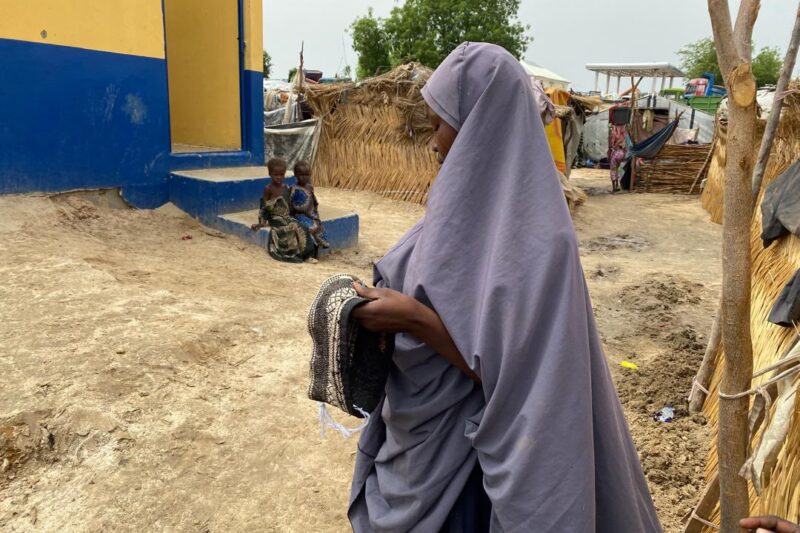
For years, survival meant food rations, hawking and uncertainty in an internally displaced persons’ settlement. Farming has begun to change that.
Every morning, before the Maiduguri sun becomes harsh, Hauwa walks to her okra farm. With no irrigation and little fertilizer, she tends the ridges herself—planting, weeding and harvesting.
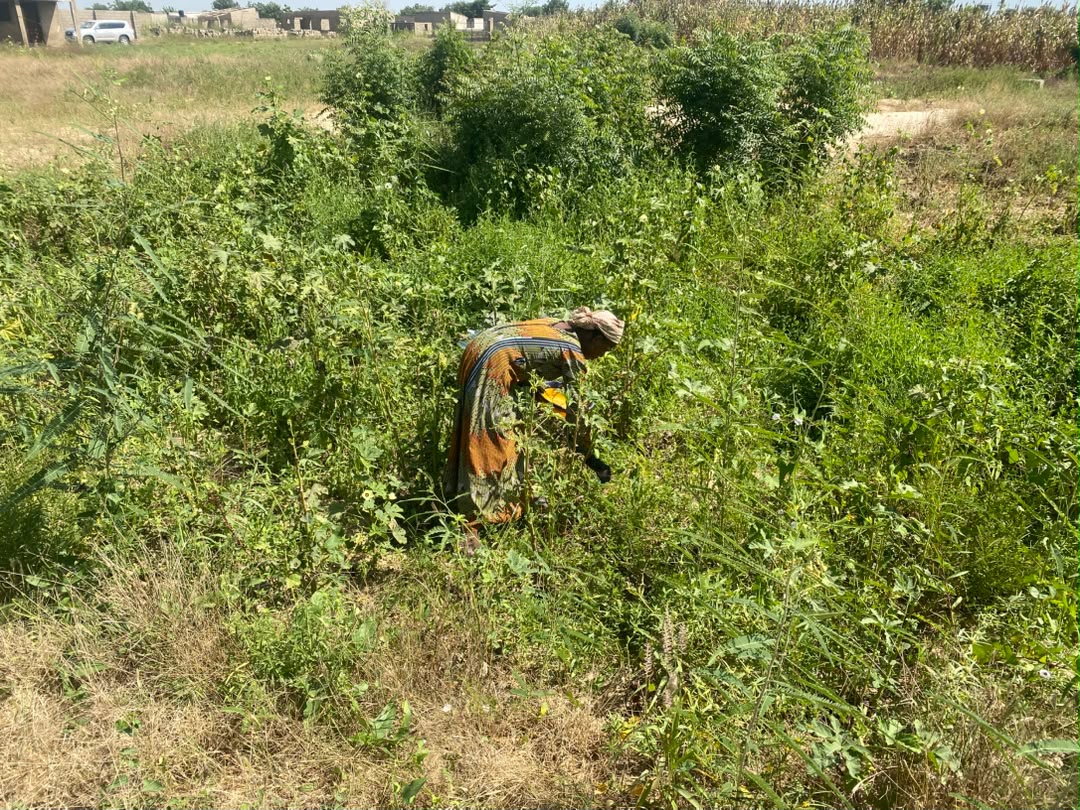
The okra she harvests feeds her family and gives her something rations never did: an income she controls.
A basin of fresh okra sells for between N2,000 and N3,000 at Gamboru Market. From the proceeds, she buys soap, schoolbooks and seeds for the next planting cycle.
“I don’t want my children to know only camp life,” she says, smiling for the first time as she holds up a handful of freshly picked okra. “I want them to know I tried.”
Hauwa’s story is not one of return—not yet. Dalwa remains unsafe for permanent resettlement.
Instead, it is a story of adaptation.
It is also the story of thousands of smallholder farmers, mostly women displaced by conflict in Northeast Nigeria, who are turning small urban farms into anchors of dignity, food security and resilience.
Hauwa does not call herself a farmer. Others do.
But in her mud-stained hands and determined gaze, resilience has a very clear picture: a young woman, displaced for nine years, choosing to plant again.
MAMMAN MAHMOOD


Leave a comment